

Student Name
Capella University
NURS-FPX4025 Research and Evidence-Based Decision Making
Professor Name
Submission Date
Analyzing a Research Paper
|
Criteria |
Analysis |
|
Type of Study |
Qualitative study using interviews. Data analyzed with content analysis. Moderate level evidence. |
|
Credibility |
Peer-reviewed journal. NIH-funded. IRB approved. Conducted by healthcare researchers. |
|
Importance of Diagnosis |
Focuses on sickle cell disease in children. Identifies barriers and facilitators to care. |
|
Application to Patient (Jamie) |
Applies to Jamie’s pain crisis. Highlights care barriers (access, delays) and supports better care coordination and education. |
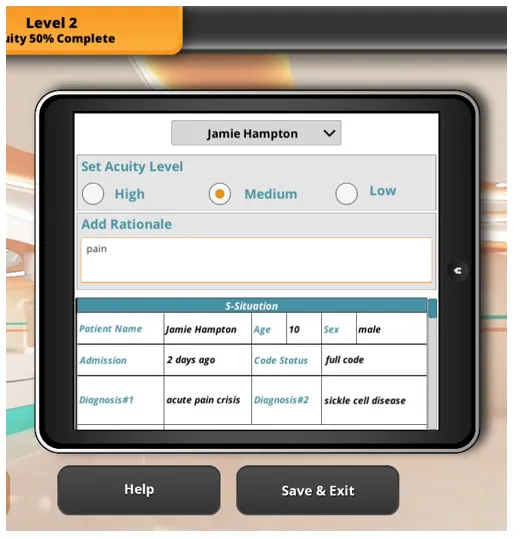
Sickle Cell Disease (SCD) is a genetic disorder characterized by the presence of abnormal, sickle-shaped red blood cells and some abnormalities in the mobility of the blood cells. This leads to complications, which cause pain, damage to organs, and decrease the quality of life. Early diagnosis in childhood and the need for specialist care throughout childhood are essential to avoid complications later in life. Children with SCD need tailored care, as this allows children to have a better quality of life and reduce complications (Schieve et al., 2022). This assignment will explain one of the journal articles on “Barriers and facilitators of holistic care for children with sickle cell disease, to care for a 10-year-old boy, Jamie Hampton, with SCD pain.
Overview of the Research Article
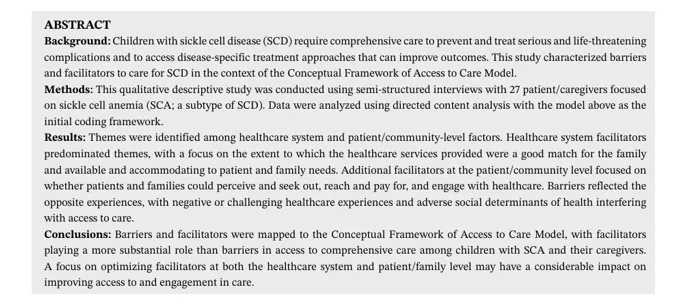
We have chosen Barriers and facilitators to pediatric sickle cell care: a qualitative descriptive study, Schlenz et al (2025), which is a qualitative descriptive study of barriers and facilitators for holistic care of children with sickle cell disease. The authors analyzed data from semi-structured interviews of 27 parents of sickle cell children. Directed content analysis was done using the Conceptual Framework of the Access to Care Model. Qualitative studies such as these provide a detailed description of the patient/caregiver experience of a problem; they can be used to understand barriers to access. Qualitative research isn’t as rigorous as quantitative research, but it does provide you with some knowledge of the problem, and you can learn from this to better care.
Credibility of the Article
For one, it’s a believable piece of writing for a couple of reasons. First, because they have published their article in a peer-reviewed journal about the topic, Pediatric Blood & Cancer. First, because it’s an NIH-sponsored study, which means it’s a measure of the quality of the study (Schlenz et al., 2025). Second, because it has received approval from the Institutional Review Board (IRB), the authors of the study have published other studies on pediatrics or hematology. Also, the study consists of data from a number of sites, making the study authentic.
Key Findings of the Study
This study highlighted that there were several factors that facilitated and obstructed sickle cell care. This was due to the positive relationship, support, and education between the parent and provider. This resulted in increased satisfaction with and engagement in health care (Schlenz et al., 2025). Need for support and support services (such as appointments, transport). The study revealed that there were issues. The issues in the health system were the lack of awareness regarding health care providers, waiting time, and appointments. The personal issues mentioned were transport, financial issues, ‘no shows’ (not showing up), and availability for employment/study (Sang et al 2025). These may impact health and health care. The most frequent power outage impacting health care was public transport.
Relevance to Sickle Cell Disease
This is significant in developing innovative solutions to the problem of sickle cell disease because sickle cell disease is a disease that needs long-term and comprehensive management. With no treatment, the signs and symptoms of the disease are pain, complications, and hospitalization. Children with SCD have a range of quality of life (QoL) needs and complications that require a range of health care services, as identified (Schlenz et al 2015). They spotlighted barriers and facilitators in accessing health care that are affecting the lives of SCD patients.
Application to Patient
This study can be used to treat Jamie Hampton’s 10-year-old child, who has sickle cell disease in crisis. Jamie suffers from pain attacks that need to be treated. Jamie might experience delays and problems with coordinating and receiving care. May not be able to make it to appointments. The study demonstrates ways to enhance the care. These include communication, education, and coordination. He’s in the care of nurses. They make sure he’s not in pain, educate him, and coordinate care (Ge et al, 2023). Therefore, with education and removing barriers and offering enablers, we can enhance the care and experience of Jamie.
Application to Practice
This research can give us some insight. This can work to help health workers (particularly nurses) address healthcare barriers. This means there will be support for transportation, and parents will be informed and supported in their health care journey. Healthcare professionals can also be more humble and practice cultural humility to care for the patient by being reflective of the patient or family (Hernandez et al., 2021). Barriers and facilitators will help the healthcare system provide the optimum health and well-being for the child with sickle cell disease.
Conclusion
The article looks at the barriers and facilitators of health care for sickle cell disease. This emphasizes the need for proper health care, communication between the patient’s family and health care professionals, and social health care support. These data help to tell Jamie Hampton’s story of barriers to care – and the importance of patient-centered care. This will help healthcare practitioners identify the barriers and facilitators to healthcare for children with SCD.
Reference
Ge, J., Zhang, Y., Fan, E., Yang, X., Chu, L., Zhou, X., Yan, Y., & Liu, W. (2023). Community nurses are important providers of continuity of care for patients with chronic diseases: A qualitative study. Inquiry, 60(1). https://doi.org/10.1177/00469580231160888
Hernandez, N. C., Leal, L. M. R., & Brito, M. J. M. (2021). Building culturally competent compassion in nurses caring for vulnerable populations. Journal of Holistic Nursing, 40(4), 359–369. https://doi.org/10.1177/08980101211062708
Sang, E., Hirschman, K. B., Stawnychy, M. A., Bin You, S., Pitcher, K. S., O’Connor, M., Oh, S., Song, J., Garren, P., Newman, B. J., & Bowles, K. H. (2025). Patient-level barriers, related facilitators, and proposed strategies for timely home health care and outpatient appointments for sepsis survivors: Perspectives from healthcare system and home health care informants. Patient Education and Counseling, 138, 109207. https://doi.org/10.1016/j.pec.2025.109207
Schieve, L. A., Simmons, G. M., Payne, A. B., Abe, K., Hsu, L. L., Hulihan, M., Pope, S., Rhie, S., Dupervil, B., & Hooper, W. C. (2022). Vital signs: Use of recommended health care measures to prevent selected complications of sickle cell anemia in children and adolescents — selected U.S. states, 2019. MMWR. Morbidity and Mortality Weekly Report, 71(39), 1241–1246. https://doi.org/10.15585/mmwr.mm7139e1
Schlenz, A. M., Vestal, E., Abrams, C. M., Kanter, J., & Phillips, S. (2025). Barriers and facilitators to comprehensive pediatric sickle cell care: A qualitative study. Pediatric Blood & Cancer, 72(5), e31603. https://doi.org/10.1002/pbc.31603